
Notes for engineers and QSs
Short, practical notes for engineers, QSs and procurement teams specifying precast in the UAE. No brochures, no theory — the decisions that come up on real jobs and what they cost you if you get them wrong.
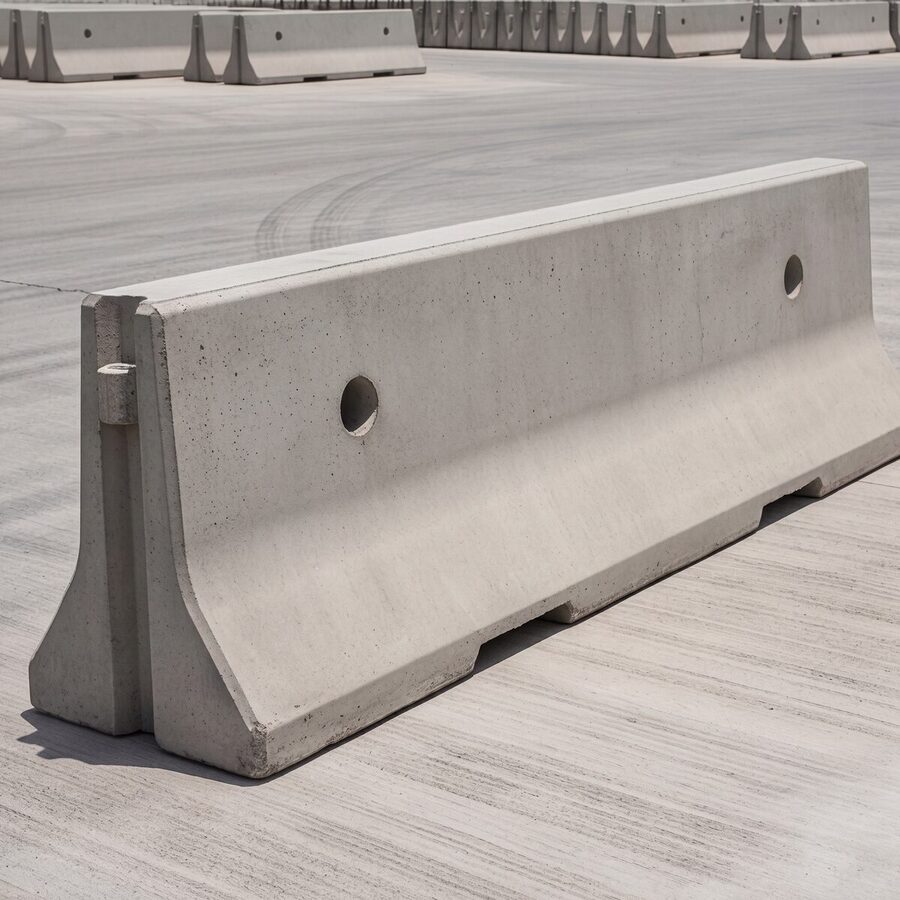
K-rail or F-type? Pick by containment, not by price
Nine times out of ten the barrier on the drawing is a K-rail because that is what the last job used. The two profiles are not interchangeable: the F-type carries a deeper toe and a different face angle, which changes how a vehicle is redirected and how much the unit shifts on impact.
For a temporary lane closure inside a compound, a pin-connected K-rail is the right unit and the cheaper one. For a live dual carriageway diversion, an RTA submission will normally expect the F-type — and a set of K-rails you already own does not become compliant by adding pins. Check the containment level in the traffic management approval before you order, because the delivery is the easy part.
One practical note on quantity: order the run length plus two units. Ends get damaged in the first week and a single replacement delivery costs more than the two spares.
B125 or D400? Cover classes without the guesswork
A footpath chamber does not need a carriageway cover, and a service road chamber absolutely does. What each class actually means in wheel load, where the line falls in a car park, and why the frame bedding matters more than the class.
Read the guide →What an RTA precast submission actually needs
The file that gets approved first time: shop drawings, mix design, cube results, source certificates and the material approval reference. The order they want it in, and the two omissions that cause most resubmissions.
Read the guide →Sulphates, groundwater and why the mix matters here
Buried units in much of the UAE sit in aggressive ground. Where sulphate-resisting cement is worth the premium, where a coating does the job instead, and how to read a soil report well enough to decide.
Read the guide →Fixing wheel stoppers into a finished deck
Dowel and resin, or adhesive-set? What a post-tensioned deck rules out, the setback that keeps a 5.4 m bay usable, and how to avoid drilling into a waterproofing layer you cannot see.
Read the guide →Site access: the questions to answer before you order
Gate width, overhead cables, turning circle, ground bearing and who offloads. Five minutes on this before the order saves a wasted trailer and a day of standing time.
Read the guide →When a custom mould pays for itself
A one-off mould is a fixed cost spread over the units you order. The rough break-even against cutting and adapting standard sizes on site, and why the answer changes with the finish you need.
Read the guide →Straight answers, no call needed
The five that come up every week. Anything else, send the drawing and ask.
Do you supply without a contractor account?
Yes. Single deliveries are normal for us — one pallet of wheel stoppers to a villa site is as welcome as a framework order. Payment terms open up once we have traded a few times.
How fast can a barrier order be on site?
Twenty-four to forty-eight hours within Dubai and Sharjah for stocked sizes, given an order confirmed before midday. Northern Emirates and Abu Dhabi add a day for the trailer slot.
Can you match an existing unit on site?
Usually. Send a photograph with a tape in shot and the three key dimensions. If it is a standard profile we will identify it; if not, a mould is quoted against your quantity.
Do you offload, or do we?
Either. Tell us at the quote stage — a hiab or crane truck is priced into the delivery. If your plant is offloading, we will confirm unit weights so you can size the lift.
What paperwork comes with a delivery?
Delivery note with the batch reference on the day, DCL cube results and material certificates within the week, and shop drawings up front on anything cast to order.
Still deciding? Ask the estimator, not the internet
The people quoting your job cast and deliver these units every week. A five-minute call usually settles a spec faster than a morning of reading.