
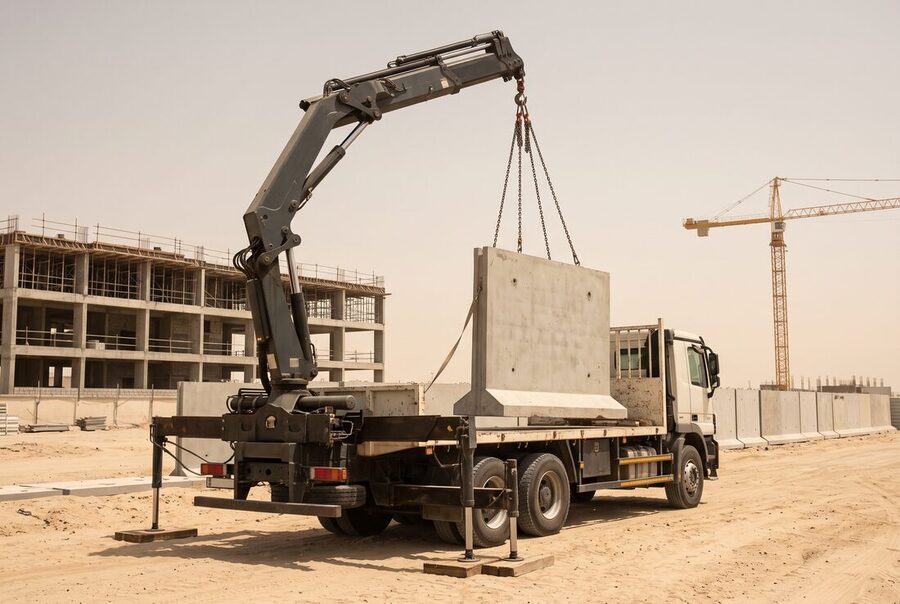
The five that stop a delivery at the gate
Almost every failed delivery we have had traces to one of five things, and all five are knowable before the order is placed. None of them is difficult to check. They just get checked after the trailer arrives instead of before.
- Gate and internal road width. A loaded flatbed needs the width plus room to swing. A gate that a pickup clears is not evidence of anything.
- Turning circle and reversing room. Long units on a long trailer need somewhere to turn around, or the driver reverses the full length of your site.
- Overhead obstructions. Cables, gantries, scaffold ties and the underside of a podium. A hiab cannot lift under a cable and will not try.
- Ground bearing. A crane truck puts its whole weight through four outrigger pads. Soft fill, a buried service, or a basement slab not designed for it are all reasons a driver will refuse to set up.
- Who offloads. If the answer has not been agreed in writing, it usually turns out to be nobody.
Match the vehicle to the access, not to the quantity
The instinct is to order the biggest load that fits the quantity, because the rate per unit is better. That is the right instinct only when the site can take the vehicle. Two smaller loads that get in beat one big load that stands at the gate.
Who offloads, and what it costs when nobody does
Standing time is the cost nobody quotes for. A vehicle waiting because the forklift is on the other side of the site, or the banksman has gone to lunch, is chargeable time and it delays every other delivery behind it that day.
Settle it at the quote: your plant and your people, or ours. If it is ours, we need to know before the vehicle is allocated, because a crane truck is a different booking from a flatbed. Deciding on the morning is how a delivery becomes two deliveries.
Tell us the offload arrangement at quote stage and it is priced in. Tell us on the day and it is a variation.
Timed access is normal — plan for it
Plenty of sites here can only take a heavy delivery inside a window: night work on a live road, a residential area with restricted hours, a school zone at drop-off, a mall handing over its service yard at a fixed time. That is ordinary and we schedule around it.
What causes trouble is a window nobody mentioned. If your access is restricted, say so with the order — a 6am slot is easy to plan for and impossible to improvise.
What to send us
A photograph of the gate and the internal route, the emirate and area, any access window, and what plant you have on site. Photographs answer more questions than descriptions, and a picture of the gate has saved more deliveries than any form we could design.
The estimator quoting your job also delivers it
Send the drawing or a photograph. You get a delivered rate, a date and a straight answer on whether the spec is right.
Do you offload, or do we?
Either — tell us at the quote stage. A hiab or crane truck is a different booking from a flatbed, so the arrangement has to be settled before the vehicle is allocated rather than on the morning.
What do you need to know about site access?
Gate and road width, turning and reversing room, overhead obstructions, ground bearing for outriggers, and who offloads. A photograph of the gate and internal route answers most of it faster than a description.
Can you deliver at night or in a restricted window?
Yes, and it is common on live roads and residential areas. Tell us the window with the order — a planned early slot is straightforward, an unannounced restriction is not.