
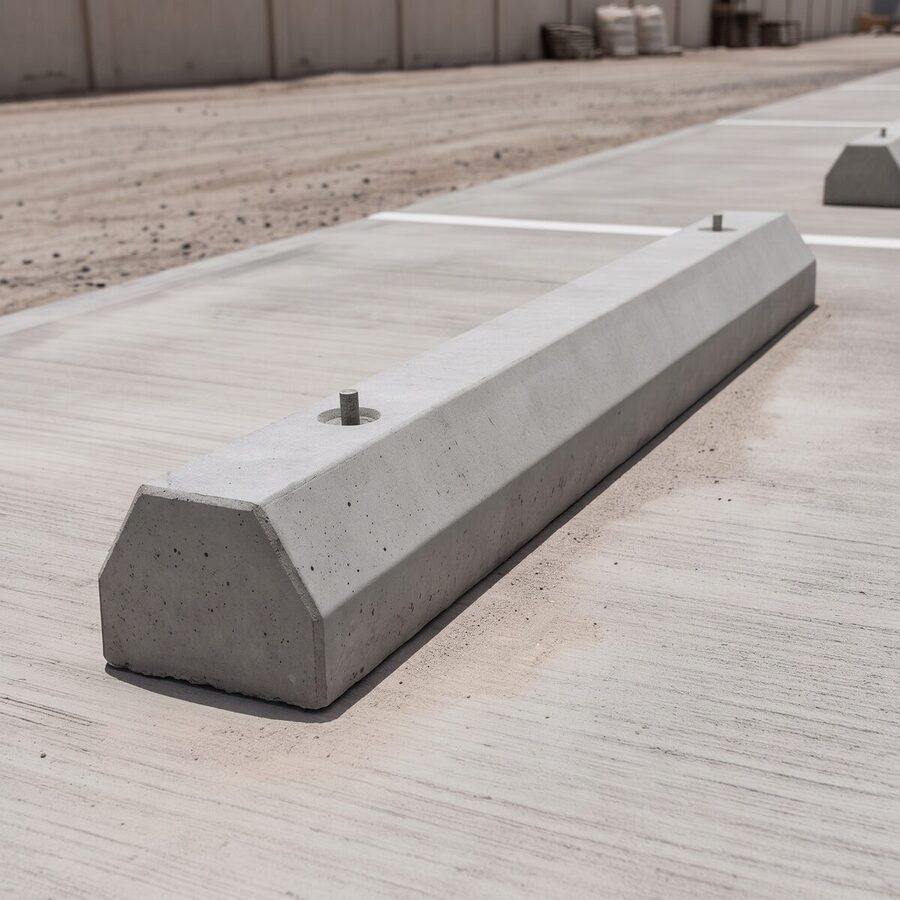
Three ways to fix one down
Dowel and resin is the default and the strongest: two holes through the cast-in ducts, rebar dowels set in resin into the slab. It needs about 100 mm of drilling depth and a slab you are allowed to drill.
Adhesive bedding sets the unit on a continuous bed of structural adhesive with no penetration at all. It holds well against the loads a wheel stopper actually sees, and it is the only option on a deck you cannot drill. It needs a clean, dry, sound substrate — it will not bond through curing compound or laitance.
Cast-in is the strongest of the three but only available on a slab you have not poured yet, which is rarely the situation by the time stoppers are ordered.
Post-tensioned decks: nothing gets drilled until it is scanned
On a post-tensioned slab a drilled hole that catches a tendon is a structural repair, not a snag. The tendon is stressed; cutting it releases that force locally and the remediation cost is orders of magnitude above the value of the stoppers.
So the sequence is not negotiable: scan first with GPR or a cover meter, mark the tendon zones, then decide. Where the scan is clear you may drill shallow. Where it is not, adhesive-set the unit and move on. If nobody will pay for a scan, adhesive-set everything — it is far cheaper than the alternative outcome.
Same rule applies to any slab with a waterproofing membrane, podium landscaping over habitable space, or embedded heating and services.
Waterproofing you cannot see
A podium or basement roof deck has a membrane under the wearing surface, and a dowel through it creates a leak path directly over occupied space. Nobody notices during installation; everybody notices in the first heavy wash-down.
Treat any deck over occupied space as undrillable unless someone with the as-built drawings tells you otherwise in writing. Adhesive bedding exists for exactly this case.
The setback that keeps the bay usable
A wheel stopper is not a kerb — it stops the wheel, and the car overhangs beyond it. Set it too close to the wall and the bumper touches; set it too far forward and you lose usable bay depth and the car protrudes into the aisle.
On a standard bay, a setback of roughly 750 to 900 mm from the wall or rear obstruction to the face of the stopper works for most vehicles. Where the bay backs onto a column, a service riser or a glazed line, take the setback from the thing you are protecting rather than from the bay marking — that is the dimension that matters.
What to send us
The deck type, whether it is post-tensioned or waterproofed, and the bay layout. We supply the dowels and resin with the stoppers on the same delivery so nothing waits on a second order, and we will say plainly if we think your deck should not be drilled.
The estimator quoting your job also delivers it
Send the drawing or a photograph. You get a delivered rate, a date and a straight answer on whether the spec is right.
How are concrete wheel stoppers fixed down?
Either two rebar dowels set in resin through the cast-in ducts, or a continuous bed of structural adhesive where the slab cannot be drilled. Dowels are stronger; adhesive is the answer on post-tensioned or waterproofed decks.
Can you drill into a post-tensioned deck?
Not until it has been scanned. Catching a stressed tendon is a structural repair costing far more than the stoppers. Scan with GPR, mark the tendon zones, and adhesive-set anywhere the scan is not clear.
How far from the wall should a wheel stopper sit?
Roughly 750 to 900 mm from the wall or rear obstruction to the face of the stopper suits most vehicles. Measure from whatever you are actually protecting — a column or riser rather than the painted line.